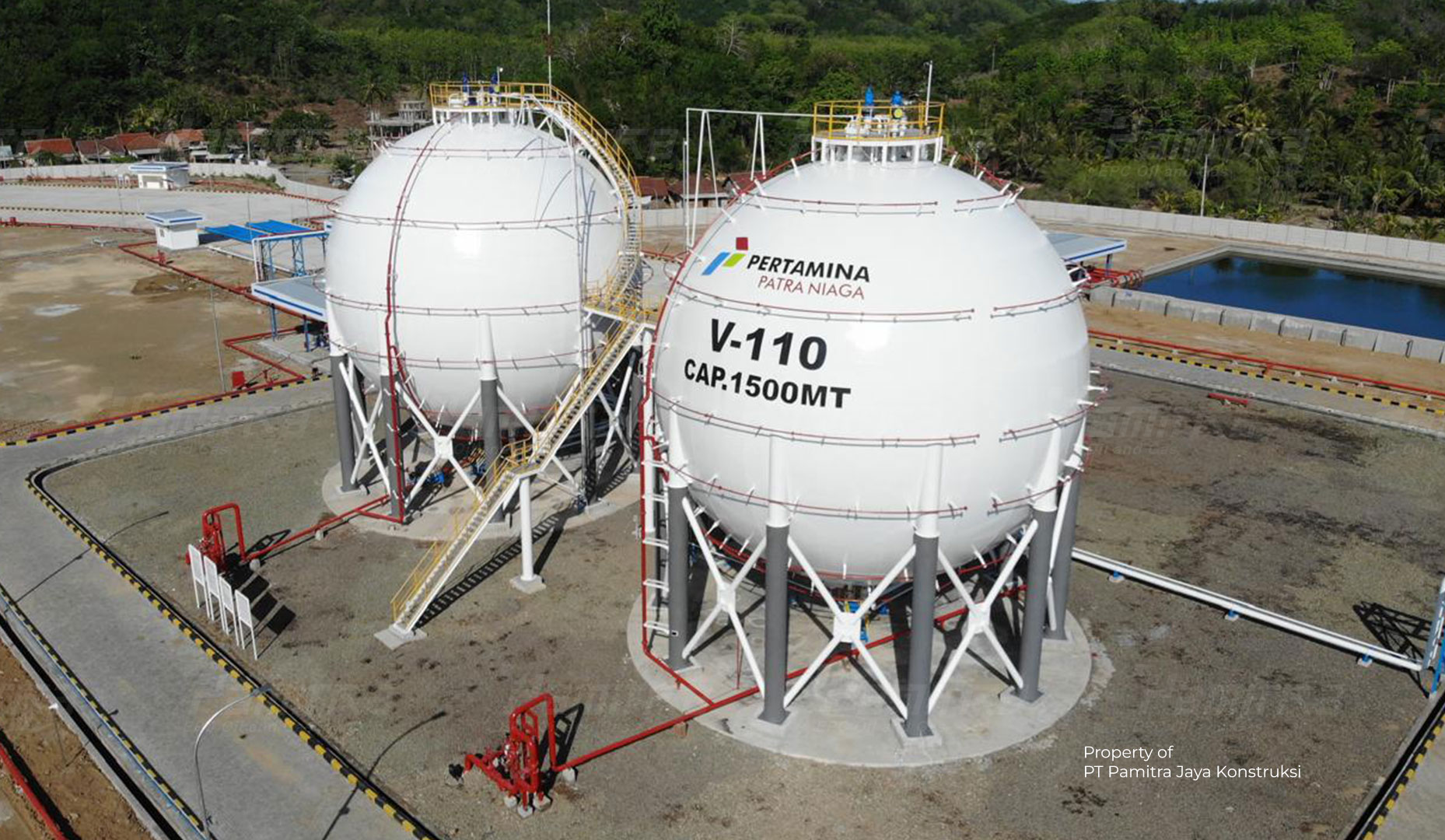
1. Atmospheric Storage Tanks
Atmospheric Storage Tanks are the most common type of tanks built in the downstream and midstream sectors, such as in Fuel Terminals or refineries. These tanks are designed to operate at or slightly above atmospheric pressure (normal air pressure). They are typically used to store liquids.
- Fixed Roof Tank: Fixed Roof Tanks have a roof that is permanently attached to the shell wall. The roof can be cone-shaped (cone roof) or dome-shaped (dome roof). Used to store liquid products with low vapor pressure (non-volatile) such as diesel, asphalt, fire water, or heavy chemicals.
- Floating Roof Tank: The roof is not permanently attached to the top wall, but rather floats directly on the surface of the stored liquid. The roof will rise and fall following the liquid volume. This is highly crucial for storing products with high vapor pressure (volatile and highly flammable) such as gasoline, aviation fuel (avtur), or crude oil. The purpose is to minimize the vapor space, thereby reducing the risk of evaporation loss and fire.
Specific Types:
- External Floating Roof Tank (EFRT) – the floating roof is exposed to the open air (there is no protective roof above it).
- Internal Floating Roof Tank (IFRT) – has a fixed roof at the top, and a floating roof inside. Provides double protection, and is often used for aviation fuel to prevent rainwater contamination.

2. Pressurized Storage Tanks
Pressurized Tanks are designed to store liquefied gases or products that have very high vapor pressure. Because the pressure is far above atmospheric pressure, the tank shape cannot be an ordinary vertical cylinder; instead, it must use a geometric shape capable of distributing the pressure evenly.
- Spherical Tank: A perfectly spherical tank supported by columns (legs). The spherical shape is the most efficient and robust design to withstand high internal pressure. Widely used to store liquefied natural gases such as LPG (Liquefied Petroleum Gas), Propane, Butane, or liquid Ammonia in the petrochemical industry.
- Bullet Tank / Horizontal Cylindrical Tank: A cylinder-shaped tank placed horizontally, with rounded ends (elliptical or hemispherical). Its function is similar to a spherical tank (for LPG or pressurized gas), but its capacity is smaller. Often used in bulk filling stations or medium-scale gas processing facilities.
3. Cryogenic Storage Tanks
Cryogenic Tanks / Very Low Temperature Tanks are specially designed not only to withstand pressure, but most importantly to maintain the temperature so that it remains extremely cold (far below freezing point).
LNG Storage Tank: LNG Storage Tanks are massive and highly complex infrastructure. They feature a double-wall structure. The inner wall is usually made of special materials (such as 9% nickel steel) that are resistant to extreme temperatures, and the space between the inner and outer walls is filled with high-level insulation material (such as perlite or a vacuum system). Specifically used to store Liquefied Natural Gas (LNG), which must be maintained at a very low temperature of around -162°C (-260°F).
4. Special Purpose Tanks
- Underground Storage Tank / UST: Buried beneath the ground surface. Usually has a double-wall layer (double-wall fiberglass or coated steel) to prevent leakage into the soil. Commonly used in public gas stations (SPBU) or to store emergency fuel (for generators) in office or hospital areas due to limited space and security reasons against external fires.
- Silo: A tall cylinder shape with a cone or funnel-shaped bottom end (hopper). In the energy, mining, and petrochemical sectors, silos are used not for liquids or gases, but for solid objects (dry bulk materials) such as plastic pellets, cement, or pulverized coal.
Photo Info:
1. Pressurized LPG Depot Project, Spherical Tank, Lombok. Client: Pertamina Patra Niaga
2. EPC Project for 2x2500KL Fuel Tanks, Kelanis, Central Kalimantan. Client: PT Adaro Logistics